The logic of the probabilistic language Abstract


The logic of the probabilistic language
 |
Abstract
This chapter introduces probabilistic language as a necessary extension of classical clinical reasoning when diagnostic certainty is structurally unattainable. In everyday medical practice, clinicians often rely on deterministic grammar, typically expressed through propositions of the form “if , then .” Such formulations provide clarity, internal coherence, and procedural stability. However, biological systems rarely obey strict causal laws, and clinical knowledge is frequently incomplete, context-dependent, and unevenly distributed across medical specialties. The chapter explores this tension through the case of Mary Poppins, a patient affected by Orofacial Pain, whose clinical data can be coherently interpreted as Temporomandibular Disorders within a dental framework, yet remain open to alternative neurological explanations when additional electrophysiological evidence is introduced.
The conceptual foundation of the chapter rests on the distinction between two major sources of diagnostic uncertainty: subjective uncertainty and causal uncertainty. Subjective uncertainty refers to an epistemic condition affecting the clinician or the patient, arising from limited or conflicting information, rather than a property of the external world. Causal uncertainty, by contrast, concerns the instability of cause–effect relations in medicine, where associations between clinical phenomena are common but rarely exception-free. When a proposition such as holds in most cases but fails in others, clinical reasoning must shift from deterministic assertions to probabilistic ones, replacing necessity with likelihood.
Within this framework, probability is not treated as a purely mathematical ornament but as a linguistic and epistemological tool that governs incomplete knowledge. The chapter clarifies the difference between subjective probability, understood as a rational degree of belief conditioned by an information state, and objective probability, understood as statistical frequency within a reference class. In real clinical settings, these two meanings often overlap: the same numerical probability can simultaneously represent a population frequency and a justified level of confidence shared by a community of practitioners who access the same evidence.
To operationalize this approach, the chapter introduces probabilistic–causal analysis as a method for structuring diagnostic reasoning. Clinical data are represented as a set , and diagnostic hypotheses are evaluated by partitioning the patient population into subsets of causal relevance. The causal relevance parameter quantifies how strongly a proposed cause shifts the probability of a clinical outcome compared with alternative conditions. This formalism explains why a diagnosis may remain internally coherent within one specialist context while becoming incomplete when examined from another.
The chapter demonstrates that even probabilistic language does not guarantee diagnostic closure. When new data from a parallel clinical domain are introduced, the original probabilistic model may no longer capture the full causal structure of the case. This limitation motivates the transition toward fuzzy logic, where diagnostic categories are no longer treated as mutually exclusive or sharply bounded. In this way, probabilistic language is presented not as the final solution to diagnostic uncertainty, but as a necessary intermediate step toward more flexible and context-sensitive models of medical reasoning.
-
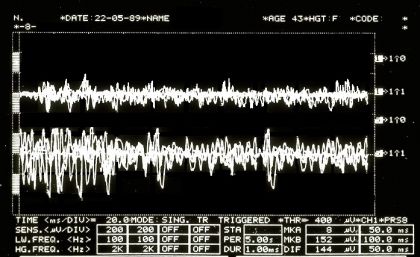 Representative clinical signal: Interferential EMG pattern showing asymmetric muscular activity. Probabilistic interpretation becomes necessary when deterministic causal attribution is not possible.


Tre domande guida (con risposte brevi)
1️⃣ Why is probabilistic language necessary in medical diagnosis?
Because many clinical situations lack deterministic causal laws. Probability allows clinicians to reason coherently when evidence is incomplete, variable, or context-dependent.
2️⃣ What is the difference between subjective and objective probability in medicine?
Subjective probability expresses a clinician’s degree of belief given available information, while objective probability reflects statistical regularities observed in populations. Both operate simultaneously in real diagnostic reasoning.
3️⃣ Why can probabilistic reasoning still fail to deliver a definitive diagnosis?
Because probabilistic coherence remains tied to the available data and the specialist context in which it is applied. When new data emerge from parallel clinical domains, diagnostic conclusions may change.
🔒 Access to the full chapter
👤 Approved users — click on your profile icon and return to the Book Index to read the complete chapter.
🔑 New readers — sign in via LinkedIn to request access.
- Vázquez-Delgado E, Cascos-Romero J, Gay-Escoda C, «Myofascial pain associated with trigger points: a literature review. Part 2: Differential diagnosis and treatment», in Med Oral Patol Oral Cir Bucal, 2007».
PMID:20173729
DOI:10.4317/medoral.15.e639
- Thoppay J, Desai B, «Oral burning: local and systemic connection for a patient-centric approach», in EPMA J, 2019».
PMID:30984309 - PMCID:PMC6459460
DOI:10.1007/s13167-018-0157-3
- Sadegh-Zadeh Kazem, «Handbook of Analytic Philosophy of Medicine», Springer, 2012, Dordrecht».
ISBN: 978-94-007-2259-0
DOI:10.1007/978-94-007-2260-6
- Sarkar S, «Nagel on Reduction», in Stud Hist Philos Sci, 2015».
PMID:26386529
DOI:10.1016/j.shpsa.2015.05.006
- Pantoja LLQ, De Toledo IP, Pupo YM, Porporatti AL, De Luca Canto G, Zwir LF, Guerra ENS, «Prevalence of degenerative joint disease of the temporomandibular joint: a systematic review», in Clin Oral Investig, 2019».
PMID:30311063
DOI:10.1007/s00784-018-2664-y
- De Toledo IP, Stefani FM, Porporatti AL, Mezzomo LA, Peres MA, Flores-Mir C, De Luca Canto G, «Prevalence of otologic signs and symptoms in adult patients with temporomandibular disorders: a systematic review and meta-analysis», in Clin Oral Investig, 2017».
PMID:27511214
DOI:10.1007/s00784-016-1926-9
- Bonotto D, Penteado CA, Namba EL, Cunali PA, Rached RN, Azevedo-Alanis LR, «Prevalence of temporomandibular disorders in rugby players», in Gen Dent, 2019».
PMID:31355769
- da Silva CG, Pachêco-Pereira C, Porporatti AL, Savi MG, Peres MA, Flores-Mir C, De Luca Canto G, «Prevalence of clinical signs of intra-articular temporomandibular disorders in children and adolescents: A systematic review and meta-analysis», in Am Dent Assoc, 2016». - PMCID:26552334
DOI:10.1016/j.adaj.2015.07.017
- Gauer RL, Semidey MJ, «Diagnosis and treatment of temporomandibular disorders», in Am Fam Physician, 2015».
PMID:25822556
- Kohlmann T, «Epidemiology of orofacial pain», in Schmerz, 2002».
PMID:12235497
DOI:10.1007/s004820200000
- Westmeyer H, «The diagnostic process as a statistical-causal analysis», in APA, 1975».
DOI:10.1007/BF00139821
- Boon M, Van Baalen S, «Epistemology for interdisciplinary research – shifting philosophical paradigms of science», in Eur J Philos Sci, 2019». - PMCID:PMC6383598
DOI:10.1007/s13194-018-0242-4
- Boon M, «An engineering paradigm in the biomedical sciences: Knowledge as epistemic tool», in Prog Biophys Mol Biol, 2017».
DOI:10.1016/j.pbiomolbio.2017.04.001