


Abstract =
This chapter introduces the logic of probabilistic language as an essential extension of classical medical reasoning when clinical certainty cannot be achieved. In many diagnostic situations—especially in complex conditions such as Orofacial Pain—the deterministic structure of classical logic (“if A, then B”) proves insufficient to account for uncertainty, variability, and incomplete causal knowledge.
Through the recurring clinical case of Mary Poppins, the chapter shows how probabilistic reasoning allows clinicians to operate meaningfully in the presence of both subjective uncertainty (degrees of belief) and objective uncertainty (statistical regularities). The probabilistic framework does not replace clinical judgment; rather, it makes explicit the epistemic conditions under which diagnoses are formulated, compared, and revised.
The chapter clarifies the distinction between subjective probability (as a quantified state of conviction) and objective probability (as frequency or propensity), showing how both are indispensable in medical language. By introducing probabilistic–causal analysis and the concept of causal relevance, the text demonstrates how partitioning patient data into clinically meaningful subsets improves differential diagnosis without claiming absolute certainty.
Finally, the chapter highlights the structural limits of probabilistic language itself: even probabilistic coherence may remain context-bound. This prepares the conceptual transition toward fuzzy logic, where diagnostic boundaries become inherently graded rather than discrete.
Tre domande guida (con risposte brevi)
1️⃣ Why is probabilistic language necessary in medical diagnosis?
Because many clinical situations lack deterministic causal laws. Probability allows clinicians to reason coherently when evidence is incomplete, variable, or context-dependent.
2️⃣ What is the difference between subjective and objective probability in medicine?
Subjective probability expresses a clinician’s degree of belief given available information, while objective probability reflects statistical regularities observed in populations. Both operate simultaneously in real diagnostic reasoning.
3️⃣ Why can probabilistic reasoning still fail to deliver a definitive diagnosis?
Because probabilistic coherence remains tied to the available data and the specialist context in which it is applied. When new data emerge from parallel clinical domains, diagnostic conclusions may change.
-
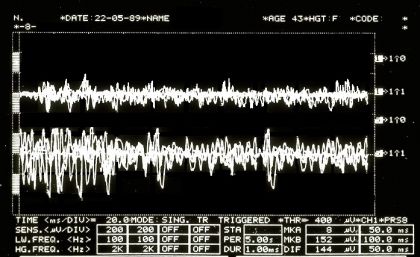 Representative clinical signal: Interferential EMG pattern showing asymmetric muscular activity. Probabilistic interpretation becomes necessary when deterministic causal attribution is not possible.

🔒 Access to the full chapter
👤 Approved users — click on your profile icon and return to the Book Index to read the complete chapter.
🔑 New readers — sign in via LinkedIn to request access.