Conclusions on the status quo in the logic of medical language regarding the masticatory system Abstract
Conclusions on the status quo in the logic of medical language regarding the masticatory system
 |
Article by: Gianni Frisardi
|
Abstract
The “Introduction” chapter establishes the conceptual and epistemological framework upon which the entire Masticationpedia project is built. Its primary objective is to clarify why traditional diagnostic approaches in dental and masticatory medicine have progressively shown structural limitations when confronted with complex, non-pathognomonic clinical conditions. Rather than attributing these failures to individual clinical error, the chapter reframes the problem as a consequence of outdated paradigms, inadequate formal language, and insufficient integration between disciplines.
Drawing on the philosophy of science—particularly Thomas Kuhn’s notion of paradigm shifts—the chapter explains why innovative diagnostic models are often resisted within established scientific communities. Such resistance is not merely cultural or academic; it has direct clinical consequences. When diagnostic frameworks remain anchored to obsolete axioms, patients bear the cost through delayed diagnoses, inappropriate treatments, and prolonged suffering. Masticationpedia explicitly adopts a Feyerabendian stance, privileging methodological pluralism, transparency, and empirical confrontation over dogmatic adherence to inherited models.
A central theme of the chapter is diagnostic error. Contemporary medical literature is reviewed to show that misdiagnosis frequently arises from three interrelated factors: lack of standardized nomenclature, fragmented diagnostic processes, and insufficient emphasis on differential diagnosis. The diagnostic act is redefined as an “observable system” composed of the patient, the observer, the measuring instruments, and the interpretative language used to decode biological signals. Errors emerge not only from faulty data acquisition but also from ambiguous linguistic constructs and unformalized reasoning strategies.
The chapter then addresses the epistemological roots of these issues, critically examining the dominance of classical statistical reasoning—particularly the uncritical use of the P-value and population-based probabilistic inference. While these tools retain value in controlled research contexts, their limitations become evident when applied to individual patients with complex, overlapping clinical presentations. The text argues that probability alone cannot substitute for structural understanding when biological systems operate across multiple organizational levels.
This critique leads naturally to the introduction of interdisciplinary and engineering-oriented paradigms. By integrating concepts from neurophysiology, systems theory, and formal logic, the chapter proposes a shift from purely descriptive medicine toward structured, model-based diagnostics. Special attention is given to the logic of medical language, highlighting how fuzzy logic and graded truth values can more accurately represent clinical uncertainty than binary true/false classifications.
Finally, the chapter prepares the reader for the development of a novel diagnostic framework: the Index Ψ. This model aims to synthesize neurophysiological data—particularly from the trigeminal system—into a coherent, reproducible metric capable of distinguishing between “Normocclusion” and “Malocclusion” at a mesoscopic level. The introduction thus functions not merely as a preface, but as a methodological manifesto, defining the ethical, scientific, and epistemological commitments that guide the chapters that follow.
In doing so, it marks a decisive transition from traditional, anatomy-centered dentistry toward a neurophysiologically informed, system-based understanding of masticatory function.
Clinical imaging
-
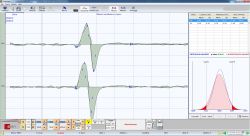 Figure 12a: Determination of the functional component of the Central Nervous System. The results for patient 1 malocclusion show an area of 1.34 mV / ms and 1.46 mV / ms on the right and left masseter respectively.
This shows a symmetry difference of 8.2%. -
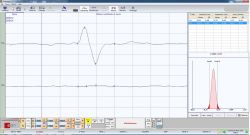 Figure 12b: Determination of the functional component of the Central Nervous System. Results for patient 2 (normocclusion) show an area of 1.37 mV / ms and 0.13 mV / ms on the right and left masseter, respectively.
This shows a 90.5% symmetry difference.


🧠 Three guiding questions (with essential answers)
1️⃣ Why do traditional diagnostic models struggle with complex masticatory disorders? — Because they rely on static anatomical observables and population-based statistics, which are insufficient to capture dynamic, neurophysiological, and system-level interactions present in individual patients.
2️⃣ Why is classical probabilistic reasoning often inadequate in clinical diagnosis? — Because tools such as the P-value and conventional Bayesian inference describe populations rather than individuals, and may fail when symptoms are non-pathognomonic or when multiple biological subsystems interact simultaneously.
3️⃣ What does the interdisciplinary, system-based approach proposed in this chapter add? — It integrates epistemology, neurophysiology, formal logic, and systems theory to model the diagnostic process as a structured observable, enabling more accurate differential diagnosis and preparing the ground for the development of the Index Ψ.
If you already have an approved account, click on your profile icon and return to the Book Index to read the complete chapter.
To access the full content, you must sign in via LinkedIn and request approval.
Bibliography & references
- Rodziewicz TL, Houseman B, Hipskind JE, «Medical Error Reduction and Prevention», in StatPearls Publishing LLC, 2022».
PMID:29763131
- Grandmaison G, Ribordy V, Mancinetti M, «Diagnostic errors : The importance of a systems approach», in Rev Med Suisse, 2021».
PMID:34495586
- Nikdel C, Nikdel K, Ibarra-Noriega A, Kalenderian A, Walji MF, «Clinical Dental Faculty Members' Perceptions of Diagnostic Errors and How to Avoid Them», in J Dent Educ, 2018».
PMID:29606650
DOI:10.21815/JDE.018.037
- Amrhein V, Greenland S, McShane B, «Scientists rise up against statistical significance», in Nature, 2019».
PMID:30894741
DOI:10.1038/d41586-019-00857-9
- Rodgers JL, «The epistemology of mathematical and statistical modeling: a quiet methodological revolution», in Am Psychol, American Psychological Association, 2010, Washington, DC».
PMID:20063905
DOI:10.1037/a0018326
- Meehl P, «The problem is epistemology, not statistics: replace significance tests by confidence intervals and quantify accuracy of risky numerical predictions», in Am Psychol, American Psychological Association, 1997, Washington, DC».
ISBN: 9781315827353
PMID:20063905
DOI:10.1037/a0018326
- Sprenger J, Hartmann S, «Bayesian Philosophy of Science. Variations on a Theme by the Reverend Thomas Bayes», Oxford University Press, 2019, Oxford, UK».
ISBN: 9780199672110
- Wasserstein RL, Schirm AL, Lazar NA, «Moving to a World Beyond “p < 0.05”», in Am Stat, Informa UK Limited, 2019».
ISSN: 1537-2731
DOI:10.1080/00031305.2019.1583913
Template:OAref
- Dettweiler U, «The Rationality of Science and the Inevitability of Defining Prior Beliefs in Empirical Research», in Front Psychol, 2019».
PMID:31456724 - PMCID:PMC6700237
DOI:10.3389/fpsyg.2019.01866
- Boon M, Van Baalen S, «Epistemology for interdisciplinary research - shifting philosophical paradigms of science», in Eur J Philos Sci, 2019».
DOI:10.1007/s13194-018-0242-4
- Boon M, «An engineering paradigm in the biomedical sciences: Knowledge as epistemic tool», in Prog Biophys Mol Biol, 2017».
DOI:10.1016/j.pbiomolbio.2017.04.001
- Codish S, Shiffman RN, «A model of ambiguity and vagueness in clinical practice guideline recommendations», in AMIA Annu Symp Proc, 2005».
PMID:16779019